Showing posts with label sign. Show all posts

Thursday, 15 August 2013

Parting shots

"There are numerous examples of the theme in Kambili. Perhaps the most notable of these involve the trial of skill which Samory Toure sets up for various soothsayers on the issue of who, among Kanji’s nine wives, will be the mother of the hero Kambili. The theme has become the appropriate unit of narration here because the contestants are going to be subjected to the same question, will fail the test on the same significant point of the woman’s name, and will fall to the same order of execution. The following are some of the soothsayers called to participate in the contest: (a) the “blackbag man” (Kamb, 305); (b) the “cowrie thrower” (40I); and (c) the “old sandal man” (443). The basic sequence of the trial is as follows. First, Samory invites the man to solve the child riddle, and the pattern of request is cearly a thematic one: (a) He spoke to the blackbag man. “Man, come help me in this child affair.” He came with his black bag. He came shaking his black bag .... (305 ff.)" The blackbag man responds:

“The bag is only for signs. It does not know people’s names (378 f.)”

From Okope 1977, Does the Epic Exist in Africa? Some Formal Considerations, in 'Research in African Literatures', Vol. 8, No. 2, Autumn, pp. 171-200


"coins that have lost their pictures and now matter only as metal, no longer as coins"

Friedrich Nitezsche in Mark C. Taylor, 1990, ‘Nuclear Architecture or Fabulous Architecture or Tragic Architecture or Dionysian Architecture or...’, in Assemblage, 11 (April). p. 9


Reed frog, Durban North, KwaZulu Natal


Still from video installation by Georgia Munnik with Pamella Dlungwana's the importance of speech giving


Leftover polystyrene from Mbali Mdluli's rub


Installation images from Goethe on Main


Stills from Georgia Munnik's video installation


"The sun was gone … We walked on in silence. I wanted to talk but knew it would mean nothing. So we were left to the settling shadows of the night. We walked, both of us, in silence. Our eyes paved the darkness that caught up with us. Friday is a bad day. When Friday night flies away it has bloody wings. We saw someone get killed. We watched, silently. We walked on and the man’s scream kept snatching our scruffs. My heart was knocking rather too loudly. We heard footsteps, running and running and running, and the night was quiet and the darkness resisted the streetlights. The scream had stopped. We took quick glances over our shoulders. The footsteps were running away from us, into the dark night.

‘They killed him,’ Moipone said at last. ‘Let’s go see.’
‘You want to eat him?’ I said, becoming angry.
‘No, but maybe we know him.’

‘Fuck it, if we knew him, we should have gone to him before they killed him’. I walked on. I could not bear to think about what had happened. I preferred to walk on, covered in the dark" 

Mongane Wally Serote, 1981, To Every Birth its Blood. Johannesburg, Ravan. p. 6-7.


Friday, 26 April 2013

the importance of speech giving

wear a grey suit, sit in front of a bland backdrop - situate yourself in the middle of the frame and proceed to communicate an important message to a wide audience. ensure that you start off slow, that you pause often, stutter here and errrr there and look as uncomfortable as you can but do not fidget or fuss at any point. 

keep your hands off screen and do not punctuate any important points with hand gestures or movement of the head. keep a flat tone, whatever you do not employ any inflections in your speech. remember this is a very important message and you want the WORLD to hear and understand it. there will be no ad break in your fifteen minute speech, all tv channels will run your very important message and select snippets for headlines later so do not fear that anyone will miss it.

when done, wait for studio personnel to count you out. you are now off air and can gesture, sweat, curse at will - you are free to express your rage, panic or fear. you have communicated your very important message.

thank you

Monday, 1 April 2013

'A' is for animal


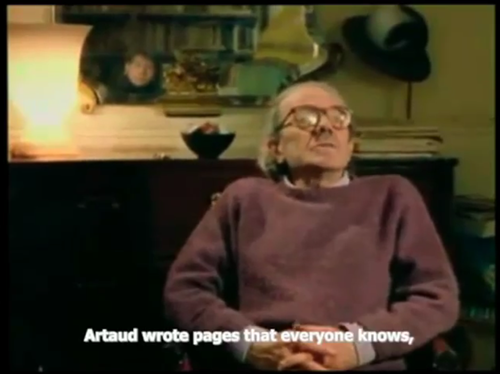
Gilles Deleuze in conversation with Clare Parnet, filmed on agreement that the tapes would only be made public after his death.

Boutang, Pierre-Andre (dir.). 2011. Gilles Deleuze from A-Z. Semiotexte